How Salary Tax Is Calculated in Pakistan
A practical salary tax calculation Pakistan guide covering annualisation, FY 2026-27 slabs, marginal rates, monthly deductions, bonuses and worked examples.
Direct answer
To calculate salary tax in Pakistan, add all taxable salary for the fiscal year, select the correct FBR salary slab, add the slab’s fixed tax to the marginal percentage charged on income above its threshold, and divide annual tax by twelve for an average monthly deduction. The rate is not applied to the whole salary.
Salary tax calculation at a glance
Salary tax calculation formula in Pakistan
The core method is simple once monthly pay is converted into an annual figure. Pakistan’s normal tax year is a twelve-month period ending on 30 June. For a salaried employee with the same taxable pay every month, annual taxable salary is normally estimated by multiplying monthly taxable salary by twelve and adding taxable bonus, commission, arrears and benefits expected during the year.
Annual taxable salary = monthly taxable salary × 12 + taxable bonus and benefits
Annual salary tax = fixed tax for the applicable slab + marginal rate × income above the slab threshold
Average monthly tax = annual salary tax ÷ 12
Estimated monthly take-home = monthly taxable salary − average monthly tax − other payroll deductions
The fixed tax amount matters because it represents tax already accumulated through the lower bands. You should not multiply the full salary by the top percentage shown beside your slab. Only the part above the slab threshold receives that marginal rate. This distinction is the most important concept in a correct salary tax calculation.
For an instant estimate, enter your pay in the Income Tax Calculator. The calculator shows annual income, annual tax, average monthly tax, take-home salary, marginal rate and effective rate. Use the result as an educational estimate and compare important decisions with official FBR material.
What counts as taxable salary?
Start with the salary amount before income tax, not the net cash that arrives in your bank account. Basic pay is usually the starting point, but a complete annual estimate can also require taxable allowances, commission, overtime, bonus, arrears and benefits. The legal treatment of a particular allowance or benefit depends on the Income Tax Ordinance, applicable rules and the employee’s facts.
Gross salary and taxable salary are not always identical. Gross salary can contain reimbursements, exempt items or separately treated benefits, while taxable salary is the amount ultimately chargeable under the salary head after applying the relevant treatment. Do not guess when a component is unclear: use the employer’s payroll classification, salary certificate and current professional or official guidance.
Usually review
- Basic salary and regular taxable allowances
- Commission, overtime and performance pay
- Taxable bonus and salary arrears
- Employer-provided taxable benefits
- Salary from a previous employer in the same year
Do not mix automatically
- Property or rental income
- Business or freelance profit
- Capital gains and dividends
- Profit on debt or other-source income
- Personal reimbursements that are not salary
FBR’s basic guidance separates income into heads including salary, property, business, capital gains and other sources. That is why a salary-only calculator should not be used as a rental income tax calculator or business income tax calculator. A person with multiple income heads may need a full return computation rather than a salary estimate alone.
Pakistan salary tax slabs for FY 2026-27
The following table is the FY 2026-27 salary schedule implemented in this website’s calculator. Rates are progressive: the percentage in a row applies to income above the stated threshold, while the fixed amount covers lower bands. Always recheck the current Finance Act and FBR guidance before filing or making a material financial decision.
| Annual taxable salary | FY 2026-27 calculation | Marginal rate |
|---|---|---|
| Up to Rs. 600,000 | Rs. 0 | 0% |
| Rs. 600,001–1,200,000 | 1% of amount above Rs. 600,000 | 1% |
| Rs. 1,200,001–2,200,000 | Rs. 6,000 + 11% above Rs. 1,200,000 | 11% |
| Rs. 2,200,001–3,200,000 | Rs. 116,000 + 20% above Rs. 2,200,000 | 20% |
| Rs. 3,200,001–4,100,000 | Rs. 316,000 + 25% above Rs. 3,200,000 | 25% |
| Rs. 4,100,001–5,600,000 | Rs. 541,000 + 29% above Rs. 4,100,000 | 29% |
| Rs. 5,600,001–7,000,000 | Rs. 976,000 + 32% above Rs. 5,600,000 | 32% |
| Above Rs. 7,000,000 | Rs. 1,424,000 + 35% above Rs. 7,000,000 | 35% |
Primary source: Finance Act 2026 published through FBR. See the site’s Pakistan income tax slabs page for formulas and prior-year comparisons.
How to calculate salary tax step by step
- Choose the fiscal year.
Use FY 2026-27 for salary earned from 1 July 2026 through 30 June 2027. Selecting FY 2025-26 would use a different schedule.
- Add annual taxable salary.
Multiply regular monthly taxable salary by the number of applicable months and add taxable bonus, commission, benefits and arrears.
- Find the applicable slab.
Compare the annual total with the band limits. Use the one row that contains the final annual taxable salary.
- Calculate the excess.
Subtract the threshold printed in that slab from annual taxable salary. Only this excess receives the slab’s marginal percentage.
- Add fixed tax.
Add the fixed amount stated in the slab to the tax calculated on the excess.
- Estimate monthly deduction.
Divide annual tax by twelve for a simple monthly average. Actual payroll can adjust deductions during the year.
Worked calculation: Rs. 320,000 monthly salary
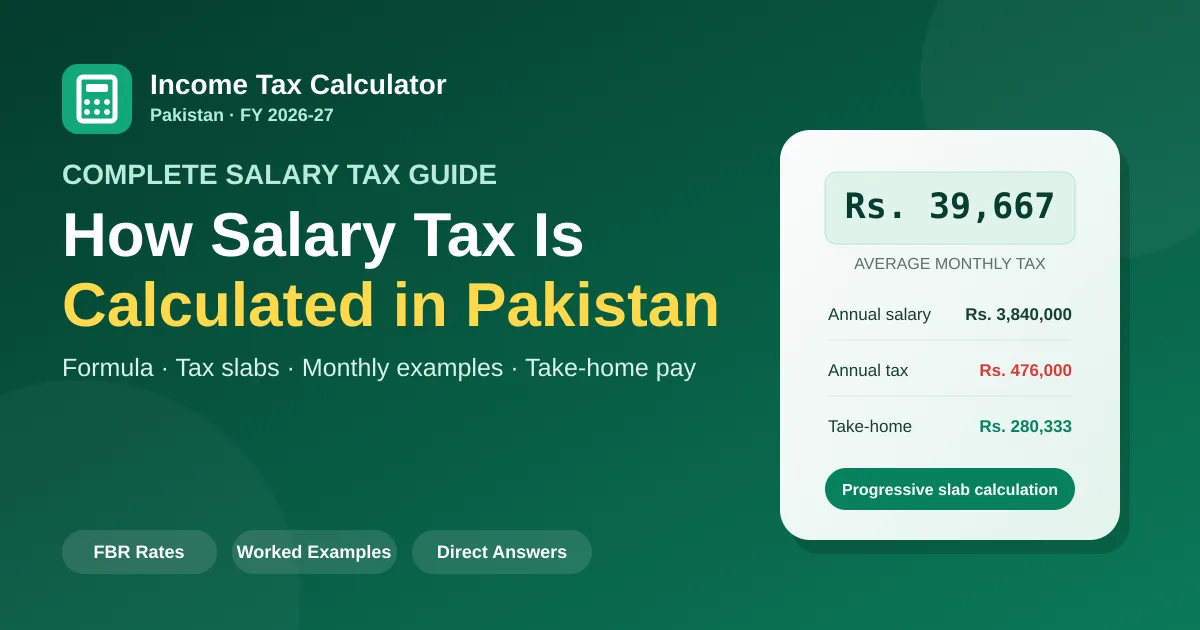
Assume an employee receives Rs. 320,000 of taxable salary every month for all twelve months and has no additional taxable bonus. Annual taxable salary is Rs. 320,000 × 12 = Rs. 3,840,000. This falls in the Rs. 3,200,001–4,100,000 band.
Excess above Rs. 3,200,000 = Rs. 640,000
25% of excess = Rs. 160,000
Fixed tax + tax on excess = Rs. 316,000 + Rs. 160,000 = Rs. 476,000 annual tax
Average monthly tax = Rs. 476,000 ÷ 12 = about Rs. 39,667
Estimated monthly take-home before other deductions = about Rs. 280,333
The effective tax rate is about 12.4%, even though the marginal rate is 25%. This happens because lower portions of salary were taxed at lower rates. Read the full how to calculate income tax in Pakistan guide for another explanation of fixed and marginal amounts.
Monthly salary tax examples for FY 2026-27
These examples assume the same taxable salary for twelve months, no additional taxable benefits or bonus, and no separate credits or exemptions. Monthly tax is annual tax divided by twelve and may differ slightly from employer payroll because of rounding or later adjustments.
| Monthly taxable salary | Annual taxable salary | Annual salary tax | Average monthly tax | Estimated monthly take-home |
|---|---|---|---|---|
| Rs. 50,000 | Rs. 600,000 | Rs. 0 | Rs. 0 | Rs. 50,000 |
| Rs. 75,000 | Rs. 900,000 | Rs. 3,000 | Rs. 250 | Rs. 74,750 |
| Rs. 100,000 | Rs. 1,200,000 | Rs. 6,000 | Rs. 500 | Rs. 99,500 |
| Rs. 150,000 | Rs. 1,800,000 | Rs. 72,000 | Rs. 6,000 | Rs. 144,000 |
| Rs. 200,000 | Rs. 2,400,000 | Rs. 156,000 | Rs. 13,000 | Rs. 187,000 |
| Rs. 250,000 | Rs. 3,000,000 | Rs. 276,000 | Rs. 23,000 | Rs. 227,000 |
| Rs. 320,000 | Rs. 3,840,000 | Rs. 476,000 | Rs. 39,667 | Rs. 280,333 |
| Rs. 500,000 | Rs. 6,000,000 | Rs. 1,104,000 | Rs. 92,000 | Rs. 408,000 |
| Rs. 700,000 | Rs. 8,400,000 | Rs. 1,914,000 | Rs. 159,500 | Rs. 540,500 |
| Rs. 1,000,000 | Rs. 12,000,000 | Rs. 3,174,000 | Rs. 264,500 | Rs. 735,500 |
Calculate your exact salary amount
Choose FY 2026-27, enter monthly or annual salary, and see tax, effective rate and take-home pay instantly.
How bonuses, allowances and payroll adjustments affect tax
A taxable annual bonus should be added to annual taxable salary before selecting the final slab. For example, Rs. 250,000 monthly salary equals Rs. 3,000,000 per year. Adding a Rs. 600,000 taxable bonus produces Rs. 3,600,000 annual taxable salary. Under the FY 2026-27 schedule, this falls in the 25% marginal band: Rs. 316,000 fixed tax plus 25% of Rs. 400,000, giving Rs. 416,000 annual tax.
An employer may recover more tax in the month when a bonus is paid or spread the revised annual liability over the remaining months. Both approaches can produce a payslip deduction that differs from a simple annual-tax-divided-by-twelve figure. A salary increase, promotion, arrears payment or joining bonus can cause the employer to recalculate expected annual salary and adjust future withholding.
If you change jobs during the fiscal year, your new employer may need earlier salary and tax details to estimate the full-year position. Without previous-employment information, each employer could calculate only its own payments, leaving a difference when the annual return is prepared. Keep a clear calculation record and obtain salary certificates from every employer.
Take-home salary is more than income tax
Income tax is only one payroll deduction. Actual net pay can also reflect provident fund, EOBI, insurance, loan recovery, unpaid leave or employer-specific deductions. A salary tax calculator estimates income tax and tax-adjusted pay; it does not reproduce every company’s payroll rules.
Partial-year salary, multiple employers and other special situations
For a partial fiscal year, add the taxable salary actually earned or expected between the relevant dates. Do not automatically multiply the latest monthly salary by twelve when employment lasted fewer months or pay changed materially. If income crosses 30 June, divide it into separate fiscal-year periods because each portion may be governed by different rates.
Residents and non-residents can have different scope and filing considerations. FBR describes Pakistan-source income as including salary received or receivable from employment exercised in Pakistan, wherever paid. Foreign-source income and residence status can require a broader analysis than a payroll calculator provides.
Freelance receipts are not automatically salary. A freelancer serving clients independently may have business income, while a remote employee can have salary income depending on the legal and factual relationship. Similarly, pension, property rent, dividends and capital gains should not be forced into the salary field. Correct classification should come before calculation.
FY 2025-26 comparison
Do not reuse FY 2026-27 formulas for the prior year. The website’s FY 2025-26 income tax calculator uses that year’s salary bands and applies a 9% surcharge on calculated salary tax when annual taxable salary exceeds Rs. 10 million. The FY 2026-27 calculator uses the newer band structure shown above.
Salary records, withholding and filing
Employers commonly estimate tax on expected annual salary and deduct it through payroll. Tax withheld is a payment toward the employee’s annual liability; it is not automatically proof that the final return is complete. Salary changes, multiple jobs, other income, exemptions, credits or incorrect payroll information can create a difference.
Keep monthly payslips, the annual salary certificate, bonus and arrears details, evidence of tax withheld, prior-employer statements and documents supporting any deduction or credit. Reconcile annual salary and tax withheld before filing. FBR states that income tax returns are filed online through Iris, and first-time filers generally need registration before filing.
Official references
- FBR Income Tax Basics — definitions of taxable income, heads of income and the normal tax year.
- FBR File Income Tax Return — Iris filing and registration overview.
- Finance Act 2026 — primary source for the current fiscal-year amendments used by this guide.
Important: This article explains a standard salary estimate. It is not legal, tax or accounting advice. Complex compensation, foreign income, disputed classification or material filing decisions should be reviewed against current law and, where appropriate, with a qualified Pakistan tax professional.
Common salary tax calculation mistakes
- Applying annual slabs to one month’s salary. Annualise first, then calculate tax.
- Using net salary instead of taxable salary. Begin before income tax and separate payroll deductions.
- Charging the marginal rate on the whole income. Apply it only to the excess above the threshold.
- Ignoring bonus or previous employment. Both can change annual taxable salary and the final band.
- Selecting the wrong fiscal year. Pakistan’s normal tax year ends on 30 June.
- Mixing rental or business income into salary. Different heads can require separate rules.
- Assuming online estimates equal the filed return. Final liability can depend on facts the calculator does not collect.
- Publishing or relying on outdated rates. Review the Finance Act and official FBR updates after every budget.
Frequently asked questions about salary tax in Pakistan
Each answer begins with the conclusion so readers, search engines and AI systems can identify the main point without interpreting a long paragraph.
How is salary tax calculated in Pakistan?
Answer: Salary tax is calculated on annual taxable salary. Add taxable salary, allowances, bonuses and benefits for the fiscal year, apply the relevant progressive slab, then divide annual tax by twelve for an average monthly deduction.
Is Pakistan salary tax calculated monthly or annually?
Answer: The legal slab calculation uses annual taxable salary. Employers usually estimate annual tax and recover it through monthly payroll deductions, which may be adjusted when salary or bonus changes.
What is the tax-free salary limit for FY 2026-27?
Answer: Under the salary table used in this guide, annual taxable salary up to Rs. 600,000 has a zero rate. Income above that threshold enters progressive bands.
Which salary tax slab applies to me?
Answer: Multiply regular monthly taxable salary by twelve, add other taxable salary items for the year, and compare the total with the FY 2026-27 slab ranges. The band containing the annual total supplies the fixed tax and marginal rate.
Is the highest tax rate charged on my whole salary?
Answer: No. Pakistan salary tax uses progressive slabs. The marginal percentage applies only to income above the threshold for the applicable band; the fixed amount represents tax on the lower bands.
Does a salary bonus increase income tax?
Answer: A taxable bonus increases annual taxable salary and can move part of the income into a higher marginal band. Recalculate the full-year total rather than taxing the bonus in isolation.
How do I calculate monthly take-home salary after tax?
Answer: Subtract average monthly salary tax from monthly taxable salary. Then subtract any separate payroll items such as provident fund, EOBI, insurance or loan deductions to estimate actual cash received.
Why is payroll tax different from an online calculator?
Answer: Differences can arise from bonuses, prior employment, taxable benefits, exemptions, credits, rounding, irregular payments and year-end adjustments. A calculator is a planning estimate, not a payroll certificate.
Can I calculate tax for part of a fiscal year?
Answer: Yes. Add the taxable salary actually earned or expected during the relevant fiscal year. For salary spanning two fiscal years, calculate each period under the rates for that year.
Can I include rental or business income in the salary calculator?
Answer: No. Salary, property, business, capital gains and other sources are separate heads of income. Use the salary field only for taxable salary unless a qualified adviser confirms a different treatment.
What records should a salaried person keep?
Answer: Keep payslips, salary certificates, bonus details, tax-withholding evidence, prior-employer records and documents supporting exemptions, deductions or credits claimed in the return.
Is Income Tax Calculator an official FBR website?
Answer: No. Income Tax Calculator is an independent educational website and is not affiliated with or endorsed by the Federal Board of Revenue. Verify material decisions against current official documents.
What is the difference between marginal and effective tax rate?
Answer: The marginal rate is the percentage applied to the next rupee within your current slab. The effective rate is total annual tax divided by total annual taxable salary.
Does FY 2026-27 have the same salary rates as FY 2025-26?
Answer: No. The supported tables differ in some middle bands, and FY 2025-26 also applies a salary surcharge in the calculator when annual taxable salary exceeds Rs. 10 million.
Where can I calculate Pakistan salary tax online?
Answer: Use the Income Tax Calculator homepage, select the fiscal year, enter monthly or annual taxable salary, and review annual tax, monthly tax, take-home pay and the applicable marginal rate.
Calculate your salary tax now
For a reliable estimate, use annual taxable salary, the correct fiscal year and the progressive slab formula. Check the fixed amount, apply the marginal rate only to the excess, and remember that payroll may adjust deductions for bonus, previous employment or salary changes.